Work Challenges You Can Conquer

People come into our coaching sessions thinking they need help with time management or difficult conversations. We thoughts we’d give you some of the professional challenges we come across most frequently and give you quick insights on how to conquer them.

Insight 1 – “I’ve Been Solving the Wrong Problem”

A general manager came to coaching frustrated that her team wasn’t stepping up. Three sessions in, she had a realisation: “I’m not giving them room to step up. I solve problems before they even know there’s an issue.”

She’d been so focused on being responsive and capable that she’d accidentally created a team that waited for her to have all the answers. The problem wasn’t their capability—it was her leadership pattern.

Key takeaway: Sometimes this just requires a focus flip: try addressing the cause, not the symptom of an issue.

Insight 2 – “My Strength Has Become My Limitation”

This is where the very thing that got you to your current position is now holding you back.

  • The detail-oriented leader who rose through the ranks by never missing anything now realises they’re micromanaging and losing strategic perspective.
  • The decisive executive who built their reputation on quick action discovers they’re moving too fast and leaving people behind.
  • The relationship-focused leader who everyone loves working with realises they’re avoiding necessary difficult conversations.

Key takeaway: Your superpower doesn’t stop being valuable—but at a certain level, if you can’t dial it back or balance it with something else, it becomes a constraint.

Insight 3 – “I’m Leading From Fear More Than I Imagined”

This one’s uncomfortable but incredibly common. In the confidential space of coaching, executives start noticing how much of their decision-making is driven by avoiding negative outcomes rather than pursuing possibilities.

“I’m not challenging that strategy because I don’t want to seem difficult.”
“I’m holding onto this underperformer because I’m worried about team morale.”
“I’m not speaking up in the executive meeting because I’m concerned about how it’ll land.”

Key takeaway: The insight isn’t that fear is bad—it’s recognising when it’s quietly running the show and making your decisions smaller than they need to be.

Insight 4 – “I’ve Been Waiting for Permission”

Perhaps the most powerful discovery is this: many capable leaders are waiting for someone to tell them they’re ready, it’s okay, they’re allowed.

Ready to have the difficult conversation. Ready to challenge the status quo. Ready to put forward the big idea. Ready to step into more senior leadership.

The coaching insight? No one’s going to give you that permission.

Key takeaway: You already have the capability—you’re just not using it.

Why These Insights Matter

These discoveries don’t happen because coaching provides magical wisdom. They happen because coaching creates the conditions for people to think more deeply than they normally give themselves time for —without judgment, with better questions, and with someone holding up a mirror.

The power isn’t in the insight alone. It’s in what becomes possible once you see clearly.

When you realise you’ve been solving the wrong problem, you can redirect your energy to what actually matters. When you understand your blind spots, you can lead more intentionally. When you’re honest about what you really want, you can make aligned choices.

It’s this kind of clarity that changes everything.

Stop Guessing, Start Asking: Our Great Questions Library Drives Clarity

How do you navigate ambiguity, get your point across in a way that brings others into the conversation or correct simple misunderstandings at work?

It’s all in the intentional habit of asking great questions.

The right question at the right time changes everything. It builds trust, gets people thinking differently and increases your influence.

Mindavation’s Great Questions Library helps you unlock success in some critical business areas. Go on, give them a try!

Elevate Your Vision and Strategy

Defining where you are going is the first step toward effective business execution. The following questions help you cut through the noise and define your shared “North Star.”

  • What does success look like? This grounds aspirational goals in specific, shared outcomes so everyone knows the score.
  • What is the area that, if we made an improvement, would give us the greatest return on time, energy, and dollars invested? This question helps prioritise efforts for maximum leverage and demonstrates your ability to lean into strategic discussions.
  • What if there were no limits? Prompting colleagues to dream big temporarily can reveal genuinely innovative possibilities and challenge old constraints.
  • If we had a magic wand, what would we really be asking for? This cuts through politeness and practicality to uncover the true desire or need beneath surface-level requests.
  • What other options do we rule out? Understanding trade-offs makes decision-making transparent and ensures you’re choosing the best path, not just the first one.

Sharpen Your Problem-Solving Skills

When faced with a challenge, powerful problem-solving skills rely on simplifying complex concepts. The following questions will help you identify a problem’s root causes and the most direct path forward.

  • What did we assume? Identifying hidden assumptions is the fastest way to expose blind spots that may be holding up your progress.
  • What’s the first step to move us forward? This breaks down overwhelming projects into manageable actions, overcoming inertia immediately.
  • What is the simplest solution here? Complexity is often the enemy of speed; this question champions quick, efficient action.

Foster Effective Communication and Support

Strong teams are built on transparency and mutual support. These queries foster effective communication by addressing unspoken needs and necessary conversations.

  • What conversations are we avoiding right now? Or, what is it that you’re trying not to tell me? Acknowledging difficult topics builds trust and removes silent barriers to alignment.
  • What do you most need right now? This simple, empathetic question ensures you offer the specific, timely support required for success.
  • What kind of support would be helpful? It moves beyond vague requests toward specific, actionable assistance.

Actionable Tips for Daily Clarity

  1. Why not try starting your next team check-in with one question selected from the list?
  2. Challenge your inner narrative by asking “What are we not saying?” during internal reviews.
  3. Use these questions as a friendly blueprint when developing next steps for a work initiative.
  4. Practice true listening after you ask a question. The insights generated are where the real value lies.
  5. Review your progress by asking, “What have we learned?”

The path to clear results and empowered teams starts not with having all the answers, but with asking the right questions.

Contact us today at [email protected] to learn how Mindavation can help your team achieve improved clarity and truly be effective at work.

Conflict isn’t a character flaw

We recently ran a Strength Deployment Inventory (SDI) session with a leadership team who thought they knew each other pretty well. Two hours in, one leader turned to a colleague and said, “So that’s why you go quiet in meetings when things get tense. I always read it as you not caring.”

She cared. A lot. She just showed it differently under pressure.

That single moment is the whole point of this work. Here are some of our most recent insights from our SDI workshops:

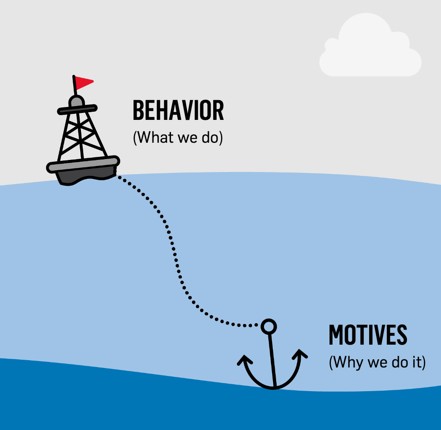
Motives are the anchor. Behaviours are the buoy.

Think of your motives like an anchor — fixed, steady, sitting on the seabed. It’s why you do what you do, and it barely shifts from your early twenties onward.

Your strengths and behaviours are the buoy on the surface. They drift and respond to the conditions around them. Two people can be tied to very different anchors and still show up with the same buoy on any given day, which is exactly why teams misread each other.

Even our best strengths can work against us

One of the ‘aha’ moments in an SDI session happens when we look at “overdone strengths” — the moment a strength gets used a little too hard for the room. Nobody sets out to overdo a strength. It’s usually well-intended, and it shows up when we’re already under pressure.

The fix isn’t to switch the strength off. It’s to notice it earlier, in yourself and others, and dial it up or down depending on who’s in front of you and what the moment calls for.

Conflict isn’t a character flaw – it’s a sequence

Here’s the SDI insight that changes how leaders handle friction in their teams: conflict behaviour runs in a predictable sequence, and almost nobody starts at their worst.

Stage one is the most productive place to resolve a disagreement, and most conflict never needs to leave it. Stage two is the “forget it, whatever” stage, where frustration starts to leak out. Stage three is self-preservation — hands thrown up, shutting down, or fighting mad. It’s rare, and it’s a sign someone feels genuinely threatened.

Once a team understands this conflict sequence, and can recognise where each other is at, the temperature can drop in a meeting and differences resolved.

The takeaway for leaders

This is about giving your teams a genuine appreciation for the ways they’re wired differently and a shared, non-judgemental language for why they sometimes clash. When teams can talk about conflict in one of Mindavation’s SDI sessions, they solve problems faster and trust each other more.

If you’re noticing recurring friction in your team, or a pattern of good people quietly misreading each other, it might be time for a conversation about what’s really driving the behaviour you’re seeing.

Mindavation has been helping teams build this kind of relationship intelligence since 1999. Get in touch to talk about running an SDI session with your team.

Contact us: [email protected]